Product Overview
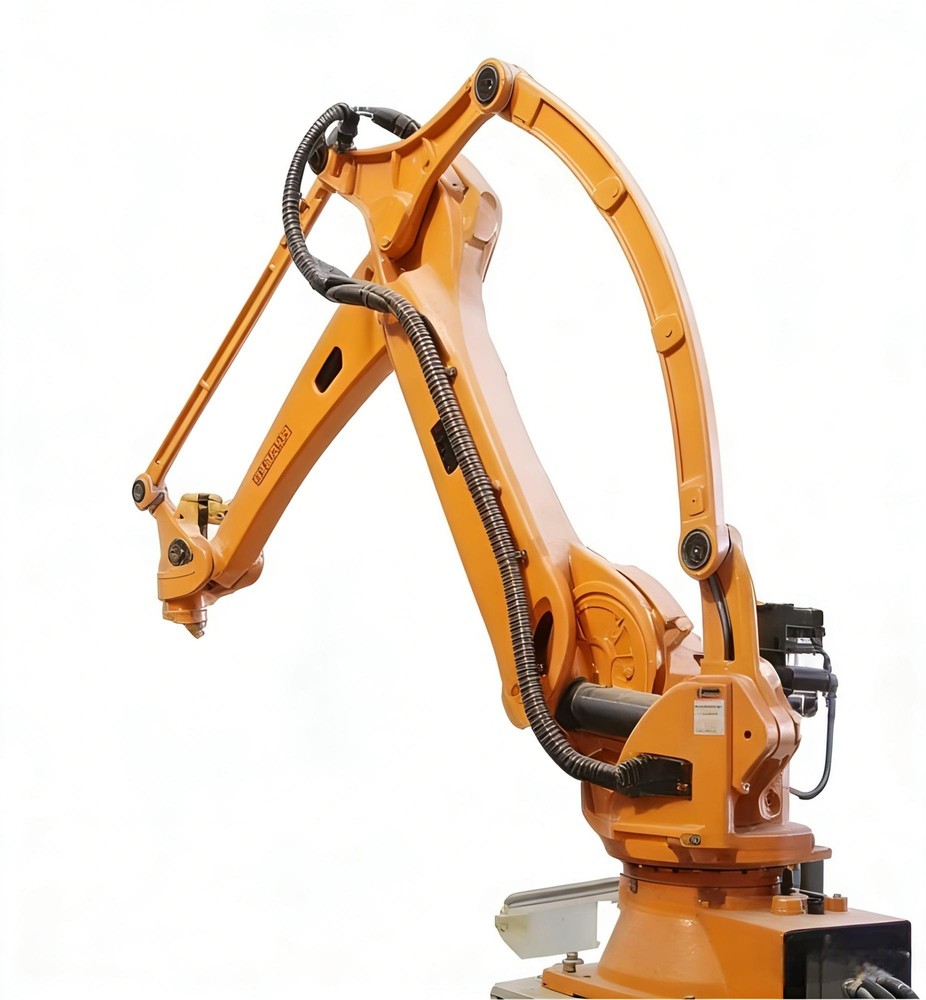
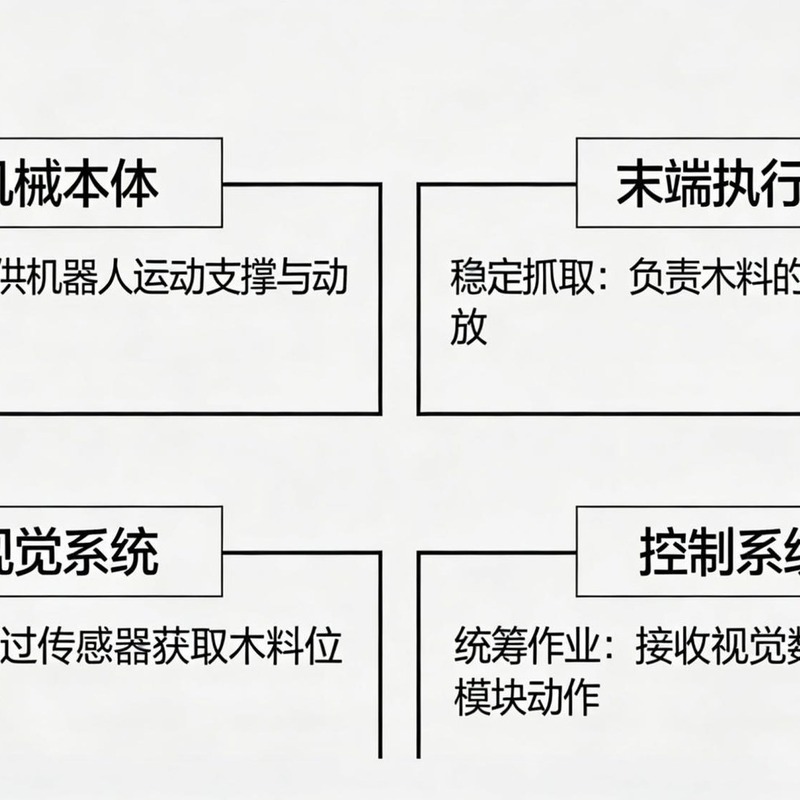
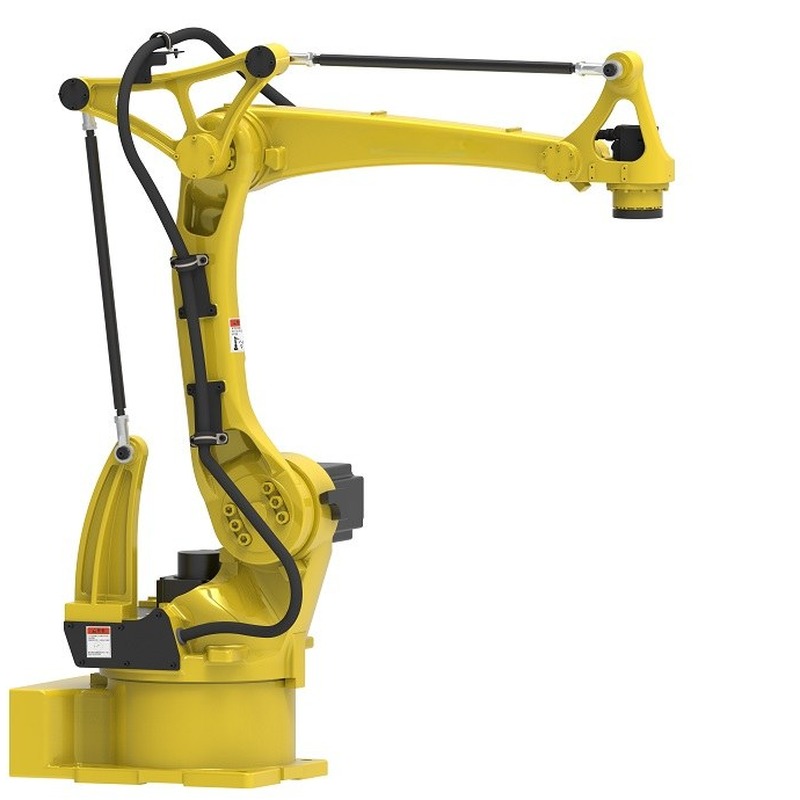
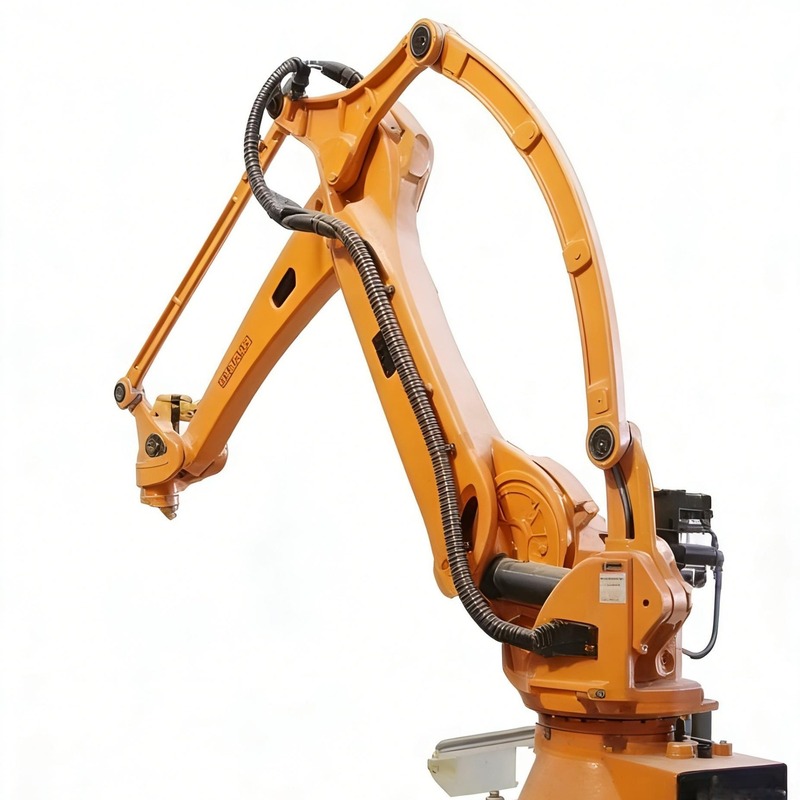
The Fully Automatic Palletizing Robot comprises a mechanical body, servo drive system, arm mechanism, end effector, and detection mechanism. By setting parameters for different material packaging, stacking sequences, and layer counts, it achieves palletizing of various packaged materials — replacing heavy manual labor and ensuring personnel safety with high stability, speed, and precision.
Product Description
Palletizing is the final — and often bottleneck — operation in many production lines: the point where finished goods are stacked onto pallets for storage or shipment. The Fully Automatic Palletizing Robot is engineered to perform this operation with a level of speed, precision, and reliability that manual labor cannot match, while simultaneously eliminating the musculoskeletal injury risks inherent in repetitive heavy lifting.
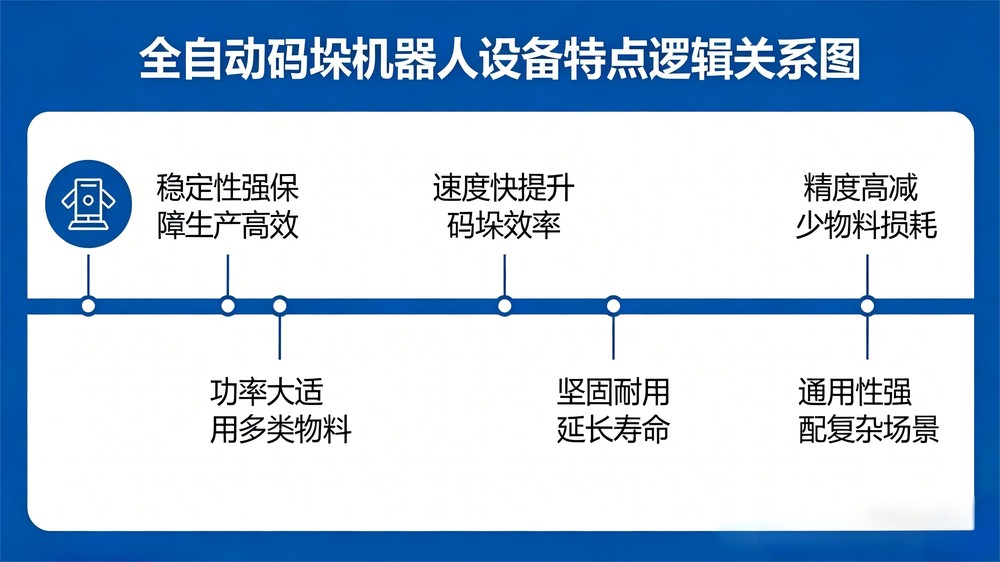
The robot's stability is fundamental to its value proposition: continuous normal operation with shorter cycle times than manual palletizing or semi-automatic systems. The standard packaging software delivers rapid response to production line flow changes, maintaining consistent palletizing efficiency regardless of upstream variation. The repeat positioning precision of ±0.03 mm ensures that every package is placed with exact positional accuracy — critical for stable pallet loads that withstand transport without toppling and for maximizing pallet space utilization through tight stacking patterns.
The robot handles a wide range of packaging types — bags, boxes, and barrels — making it suitable for diverse product lines. Its environmental resilience enables operation in extreme temperature conditions from high heat to deep cold, extending applicability to industries such as frozen food processing and hot-fill beverage production. The system's generality is remarkable: it can simultaneously manage 4 infeed conveyor lines, 2 pallet stacking positions, and 1 slip-sheet stacking position — enabling multi-product, multi-line palletizing from a single robot.
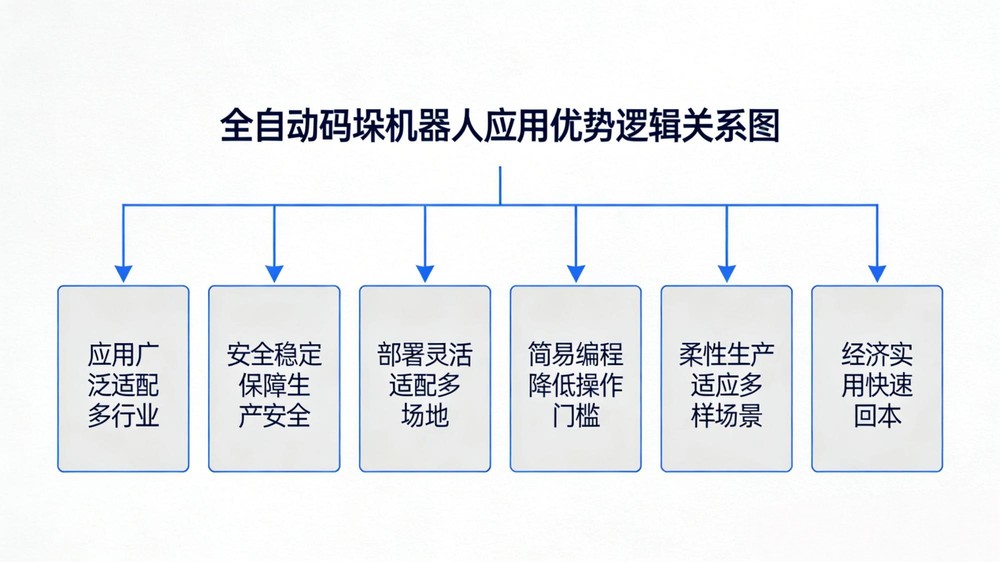
An industrial-grade force sensor provides 10-level collision detection and 16 safety I/O interfaces, ensuring that the robot operates safely even in environments where personnel interaction is required. The visual programming interface is designed for rapid operator adoption: approximately 30 minutes to master and 1 hour to complete simple palletizing task programming — dramatically reducing the specialized programming knowledge barrier that has traditionally limited robot deployment. The system supports flexible production through human-robot collaboration and dual-robot/multi-robot coordinated operation, enabling reconfigurable production cells that adapt to changing product mixes.
The economic case for the robot is compelling: investment payback period of 6–12 months, driven by labor cost elimination, throughput increase, product damage reduction, and workplace injury cost avoidance. This rapid payback makes the robot practical not only for large-scale industrial operations but for mid-size facilities seeking to improve competitiveness through automation.
Key Features
- High stability: continuous operation with shorter cycle times
- High speed: standard packaging software for rapid response
- High precision: ±0.03 mm repeat positioning accuracy
- High power: handles bags, boxes, and barrels
- Rugged: operates in extreme high/low temperature environments
- Generality: 4 infeed conveyors, 2 pallet positions, 1 slip-sheet position
- Industrial force sensor: 10-level collision detection, 16 safety I/O
- Visual programming: 30 min to master, 1 hour for simple task programming
- Flexible: human-robot and multi-robot collaboration
- Rapid payback: 6–12 month investment return
Technical Specifications
| Parameter | Value |
|---|
| Repeat Positioning Precision | ±0.03 mm |
| Infeed Conveyor Lines | 4 |
| Pallet Stacking Positions | 2 |
| Slip-Sheet Stacking Positions | 1 |
| Stacking Discharge Lines | 4 |
| Collision Detection | 10 levels |
| Safety I/O Interfaces | 16 |
| Programming Learning Time | ~30 minutes |
| Investment Payback Period | 6–12 months |
Applications
Palletizing operations across food, 3C electronics, daily chemicals, e-commerce logistics, automotive parts, photovoltaic, building materials, and logistics warehousing industries.
![]()
![]()
![]()