Product Overview
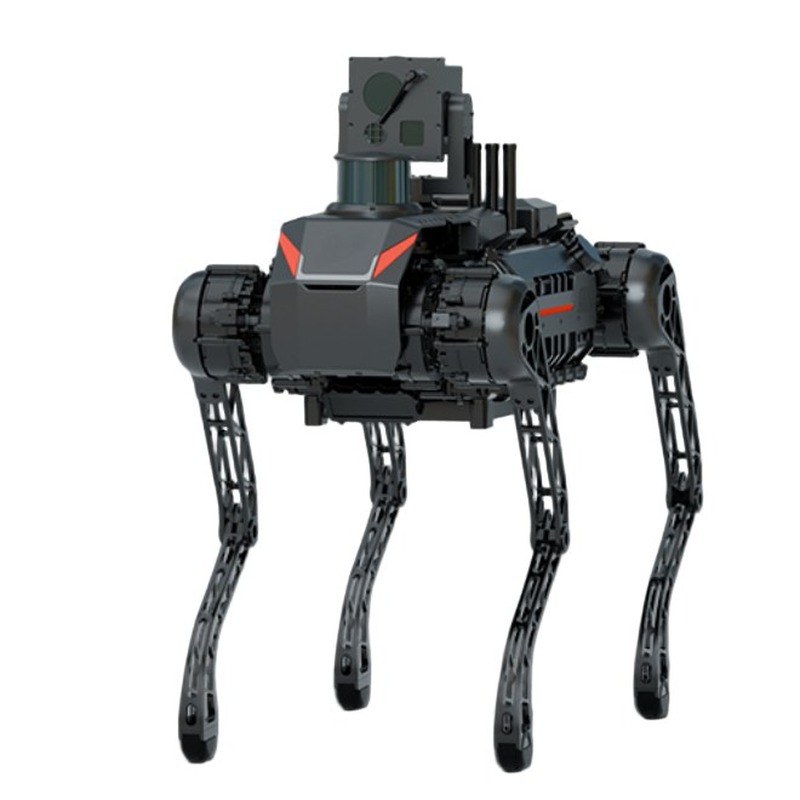
The Explosion-Proof Quadruped Robot achieves Ex IIB T4 Gb explosion-proof rating using composite explosion-proof technology (pressurization, intrinsic safety, flameproof, and potting). With 14 degrees of freedom (robot 12 + PTZ 2) and high-performance electro-hydraulic composite drive joints, it carries a 30 kg payload and moves stably across stairs, steps, gaps, obstacles, and complex terrain.
Product Description
The Explosion-Proof Quadruped Robot represents a breakthrough in robotics for hazardous environments — a legged platform that combines the terrain-negotiation capabilities of biological quadrupeds with the explosion protection required for Zone 1 deployment. Where wheeled robots are limited by stairs, gaps, and irregular obstacles, the quadruped's legged locomotion enables it to traverse the full spectrum of industrial terrain, including environments never designed for wheeled access.
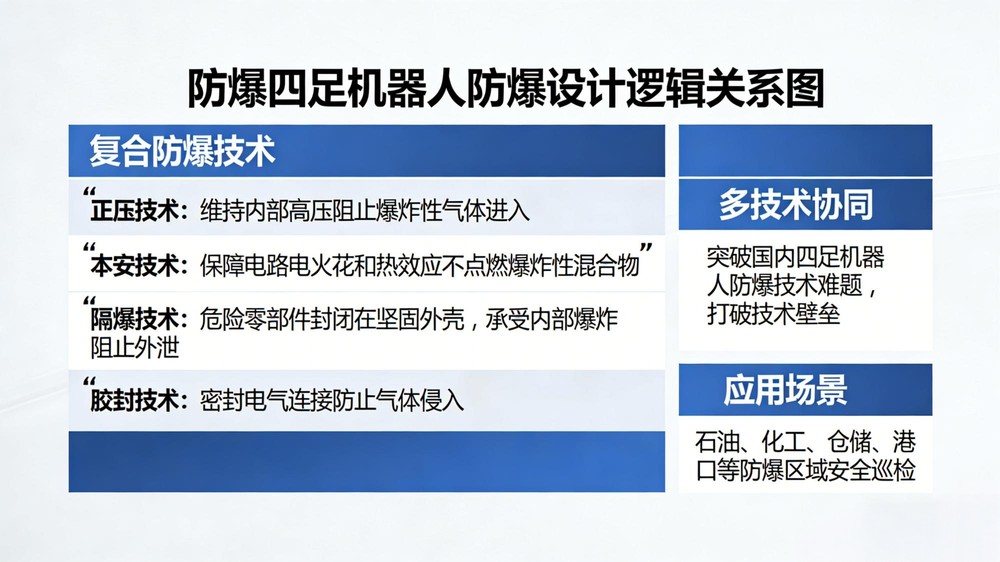
The robot's composite explosion-proof technology is a key innovation. Rather than relying on a single protection method, it combines four techniques: pressurization (maintaining internal positive pressure to exclude explosive atmosphere), intrinsic safety (limiting circuit energy to below ignition thresholds), flameproof construction (containing any internal ignition), and potting (encapsulating components in solid insulating material). This multi-layer approach overcomes the technical challenge that had previously prevented domestic quadruped robots from achieving meaningful explosion-proof ratings.
The 14 degrees of freedom — 12 for the robot body (3 per leg × 4 legs) and 2 for the PTZ — provide the kinematic flexibility needed for complex locomotion. Each leg's 3-DOF configuration enables the robot to step over 200 mm obstacles, climb stairs with maximum step height of 20 cm and minimum step width of 25 cm, cross 300 mm-wide trenches, and wade through 300 mm-deep water. The robot's climbing ability extends to slopes up to 30°, and its travel speed reaches 1.0 m/s with an operating endurance of up to 3 hours.
The high-performance electro-hydraulic composite drive joints are the powertrain that makes this locomotion possible. These joints deliver high power density (more force per unit volume than electromagnetic actuators), high impact resistance (essential for legged locomotion where ground-contact forces are impulsive), high transmission efficiency, and high control performance (enabling precise force and position control for stable dynamic walking). The repeat positioning accuracy of ≤±5 cm and SLAM laser navigation ensure that the robot knows its position in the environment even as its body configuration changes continuously during walking.
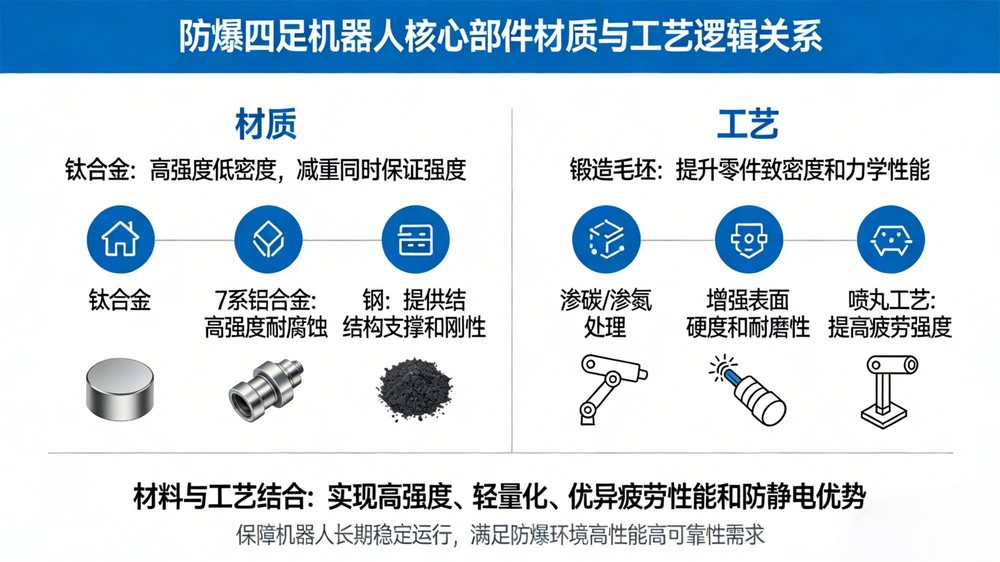
The robot's core components are manufactured from high-strength materials — titanium alloy, 7-series aluminum alloy, and steel — selected for their strength-to-weight ratio and corrosion resistance. Advanced manufacturing processes including forging blanks, carburizing/nitriding treatment, and shot-peening ensure component durability under the demanding load cycles of legged locomotion. The robot carries 500+ intelligent algorithms that enable autonomous terrain assessment, gait selection, obstacle avoidance, and mission execution. With a 30 kg payload capacity, the robot can carry inspection sensors, communication equipment, or emergency response tools into hazardous areas that are inaccessible to both wheeled robots and human personnel.
Key Features
- Composite explosion-proof technology: pressurization + IS + flameproof + potting
- 14 DOF (robot 12 + PTZ 2) for complex terrain locomotion
- High-performance electro-hydraulic composite drive joints
- 30 kg payload with ≤±5 cm repeat positioning accuracy
- SLAM laser navigation and positioning
- Core components: titanium alloy, 7-series aluminum, steel
- Advanced manufacturing: forged blanks, carburizing/nitriding, shot-peening
- 500+ intelligent algorithms for autonomous operation
- Terrain adaptability: stairs, steps, gaps, obstacles, confined spaces
Technical Specifications
| Parameter | Value |
|---|
| Explosion-Proof Rating | Ex IIB T4 Gb |
| Dimensions | ≤1200 mm × 600 mm × 800 mm |
| Curb Weight | ≤100 kg |
| Degrees of Freedom | 14 (robot 12 + PTZ 2) |
| Climbing Ability | ≤30° |
| Obstacle Crossing | 200 mm |
| Wading Depth | 300 mm |
| Stair Climbing | Max step 20 cm, min width 25 cm |
| Trench Crossing | 300 mm |
| Travel Speed | 0–1.0 m/s |
| Operating Endurance | ≤3 h |
| Repeat Positioning Accuracy | ≤±5 cm |
| Protection Rating | IP66 |
| Navigation Method | SLAM laser navigation |
| Payload | 30 kg |
| Core Component Materials | Titanium alloy, 7-series aluminum, steel |
Applications
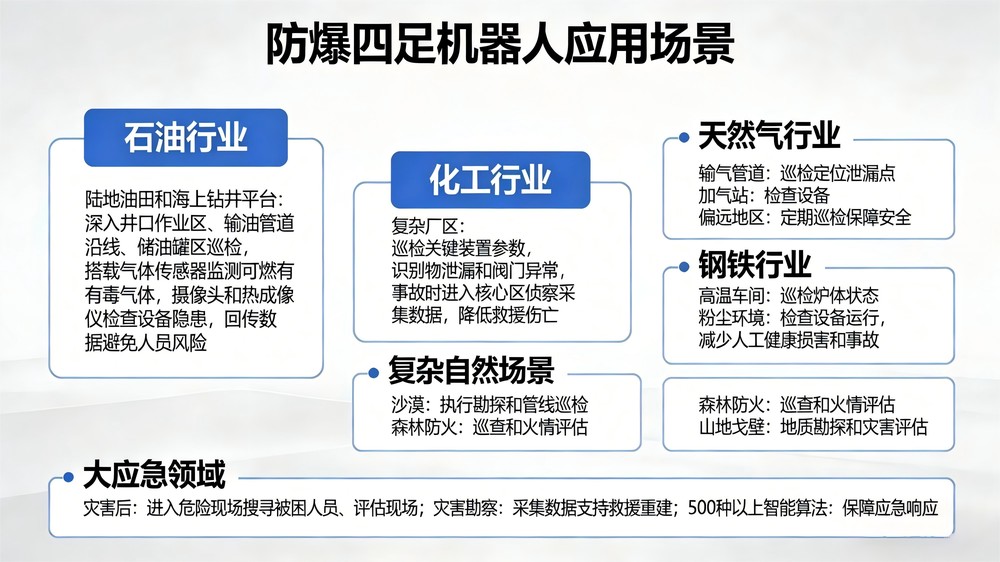
Petroleum, chemical, natural gas, steel, and other industrial danger zone inspection; desert, forest, mountain, and gobi complex natural terrain; emergency rescue and disaster survey.
![]()
![]()
![]()