Product Overview
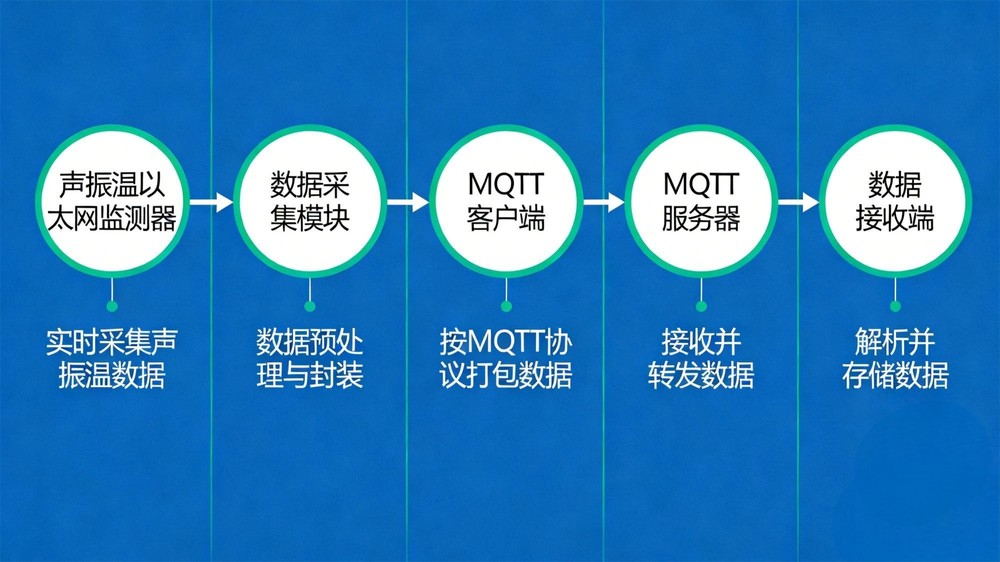
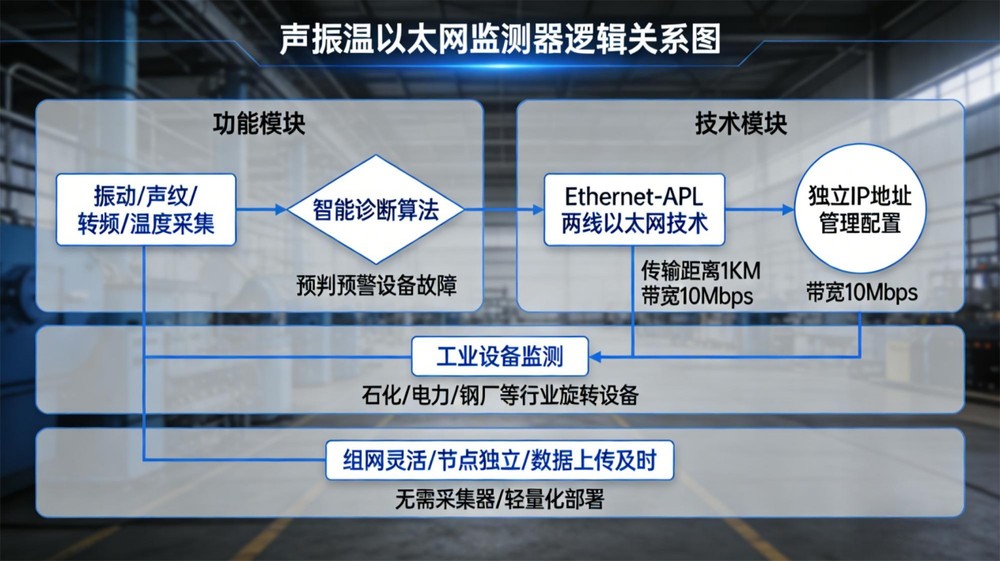
The Acoustic-Vibration-Temperature Ethernet Monitor integrates vibration, acoustic signature, rotational frequency and temperature sensing with intelligent diagnostic algorithms. It uses Ethernet-APL two-wire Ethernet technology, giving each sensor an independent IP address for management and configuration. With transmission distance up to 1 km and bandwidth up to 10 Mbps, it supports flexible networking and timely data upload.
Product Description
In plants where an industrial Ethernet backbone already exists, the fastest path to comprehensive condition monitoring is a sensor that speaks the network's own language. The Acoustic-Vibration-Temperature Ethernet Monitor does exactly that. It packages acoustic, vibration, rotational-frequency and temperature sensing with intelligent diagnostic algorithms, then connects directly to the plant network using Ethernet-APL two-wire Ethernet technology. Each sensor receives its own IP address, so it can be individually managed, configured and addressed — a level of granularity that polling-based fieldbus architectures cannot provide.
The physical layer is designed for practical industrial distances: transmission up to 1 km and bandwidth up to 10 Mbps over two wires. This is sufficient for timely upload of measurement data while remaining compatible with long cable runs in large facilities. Because each monitor is addressable and self-contained, there is no need for a separate collector or gateway device between the sensor and the network — a simplification that cuts hardware cost and reduces the number of components that can fail.
For lightweight field deployments, this architecture is particularly attractive. A maintenance engineer can connect a monitor to the nearest switch, assign it an address, and have live equipment-status data flowing into the monitoring system within minutes. The combination of addressable networking, long reach and rich multi-physics sensing makes the Ethernet monitor a strong building block for plant-wide monitoring modernization.
Key Features
- Acoustic, vibration, rotational frequency and temperature sensing with intelligent diagnostics
- Ethernet-APL two-wire Ethernet technology, no separate collector required
- Individual IP address per sensor for management and configuration
- Transmission distance up to 1 km
- Bandwidth up to 10 Mbps
- Lightweight field deployment with rapid data upload
Technical Specifications
| Parameter | Value |
|---|
| Sensing Modalities | Acoustic, vibration, rotational frequency, temperature |
| Network Technology | Ethernet-APL two-wire Ethernet |
| Addressing | Independent IP address per sensor |
| Max Transmission Distance | 1 km |
| Bandwidth | Up to 10 Mbps |
| Collector | Not required |
Applications
Plant-wide condition monitoring over existing industrial Ethernet, motor and rotating equipment diagnosis, and lightweight field deployment of vibration and temperature monitoring networks.
![]()
![]()
![]()