

What Is Smart Mining? A Complete Guide to Intelligent Mine Technology
Smart mining is the integration of 5G communication, industrial IoT sensors, AI video analysis, UWB personnel positioning, robotic inspection and big data platforms into a single digital operation, enabling mines to monitor every production and safety process in real time. Instead of relying on manually read gauges, paper logbooks and reactive maintenance, a smart mine turns the whole operation into a connected data stream: sensors detect gas levels, cameras recognize safety violations within seconds, inspection robots patrol hazardous galleries, and an AI brain platform correlates the data to predict failures before they happen. For mining companies, the result is measurable — fewer people underground, less unplanned downtime and a materially safer working environment.
Why Do Mines Around the World Need Intelligent Technology?
Mining is becoming harder. Deposits are deeper, grade is lower, labor costs are rising and safety regulators demand continuous, auditable monitoring. At the same time, communication technology has crossed a threshold: underground 5G networks can now carry video, telemetry and control commands with the low latency that robotic and remote operation requires.
Smart mining is not a single product — it is an architecture. Most successful deployments combine the following layers:
| Layer | What It Does | Typical Building Blocks |
|---|---|---|
| Communication | Carries data from underground to surface in real time | Underground 5G, WiFi6, fiber backbone |
| Sensing | Measures environment, equipment and human activity | Gas sensors, thermal cameras, vibration sensors |
| Positioning | Tracks personnel and vehicles with sub-meter accuracy | UWB anchors and tags integrated with wireless network |
| AI analysis | Turns video and sensor streams into automated decisions | Computer vision, video anti-violation analysis |
| Robotic inspection | Performs patrols in hazardous areas without human exposure | Intrinsically safe inspection robots |
| Decision platform | Correlates all data for dashboards, alarms and predictions | Mine AI brain / big data platform |
What Are the Core Technologies Behind a Smart Mine?
Underground 5G and Converged Communication
The nervous system of a smart mine is its communication network. A converged underground network using fiber as the backbone and 5G for mobile, latency-sensitive applications lets cameras, sensors, robots and personnel tags share one platform. Pengxiang's Mining 5G Integrated Communication System implements exactly this converged approach, with Ex i-certified remote units designed for underground coal mines, so operators avoid installing separate cabling for every subsystem.
AI Video Analysis for Safety Compliance
Fixed and mobile cameras are only as valuable as the analysis behind them. Modern systems such as Pengxiang's Mine Video Anti-Violation Intelligent Analysis System process every camera feed in real time to detect PPE non-compliance, restricted zone entry, behavioral anomalies and equipment hazards — reducing the workload of manual video review and turning surveillance from a reactive tool into a preventive one.
UWB Personnel Positioning
Knowing where every worker is, in real time, changes how mines manage safety and evacuation. Ultra-wideband (UWB) positioning achieves 0.2–1.0 meter accuracy underground, which is 10–50 times more accurate than WiFi or Bluetooth-based methods. Pengxiang's Mine Personnel Management System uses UWB anchors integrated with the mine's 5G network to provide real-time positioning, attendance management, geofencing and emergency response.
Robotic Inspection in Hazardous Zones
Inspection robots equipped with thermal imaging cameras, gas detectors, vibration sensors and audio pickups patrol belt conveyors, pump stations and substations continuously — removing personnel from explosive atmospheres and toxic environments. Pengxiang's Mining Intrinsically Safe Inspection Robot combines intrinsically safe sensor payloads with a robust mobile platform, and its Explosion-Proof Wheeled Robot extends the same capability to surface and semi-hazardous duty.
The AI Brain and Big Data Platform
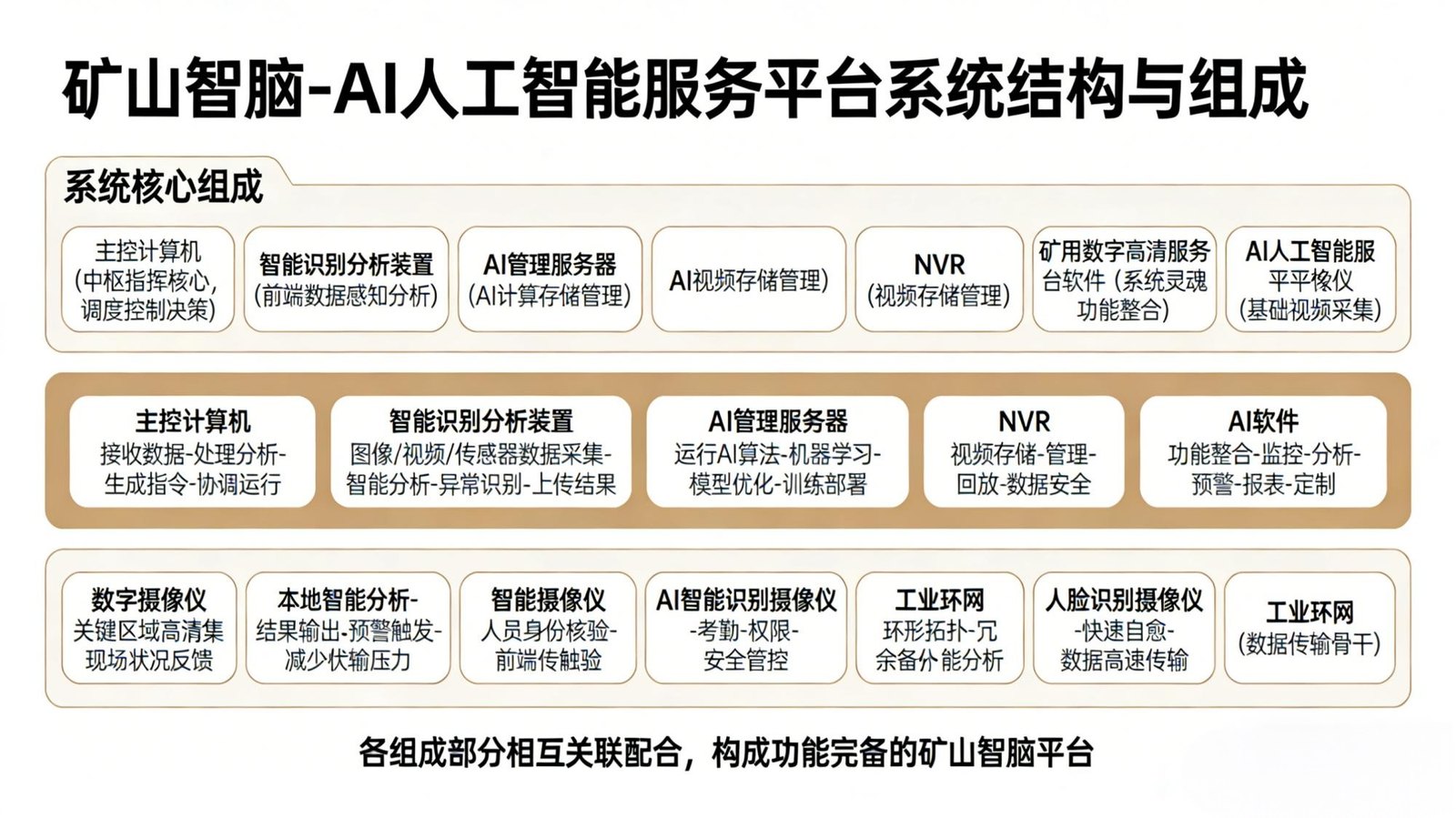
All of these subsystems generate data — but data alone is not intelligence. A central platform correlates video, gas, positioning, equipment status and production data into one operational picture. Pengxiang's Mine AI Brain Platform (矿山智脑) serves as this hub, while the Mine Big Data Analysis Platform provides the analytics, reporting and predictive models that help mines turn information into decisions.
How Does a Smart Mine Work in Practice?
A typical deployment starts with connectivity: the 5G network is rolled out along main galleries, with Ex i-certified remote units and fiber distribution. On top of the network, mines deploy sensors and cameras; UWB anchors are installed at 80–120 meter spacing so that personnel tags report continuous positions. Inspection robots are programmed to patrol defined routes automatically, streaming thermal and visual data back to the surface control room. Finally, the AI brain platform ingests all streams and presents a unified dashboard: when a violation is detected, a geofence is crossed, or a motor temperature exceeds a threshold, the system alarms the control room in seconds — and logs the event for compliance reporting.
For example, in a large coal mine in Shandong Province, a transformation built on Pengxiang's Mining 5G Integrated Communication System, Mine AI Brain Platform and Mining Intrinsically Safe Inspection Robot reduced underground personnel by 38%, cut unplanned downtime by 52% and achieved zero safety incidents over 18 months after deployment.
What Are the Measurable Benefits?
| Benefit | Typical Outcome |
|---|---|
| Safety | Real-time violation detection, geofencing and robotic inspection reduce human exposure in hazardous zones |
| Productivity | Data-driven dispatch and predictive maintenance cut unplanned downtime |
| Compliance | Automated, timestamped logs make safety auditing simple and defensible |
| Labor efficiency | Robotic patrols and remote monitoring reduce underground inspection manpower |
How Do You Start Your Smart Mine Transformation?
- Audit your existing infrastructure — inventory current sensors, cameras, networks and control systems.
- Fix the communication layer first — a reliable underground 5G/fiber network is the foundation for everything else.
- Start with one high-ROI use case — for most mines, personnel positioning or AI video safety analysis delivers fast, visible wins.
- Choose certifiable equipment — in coal mines, every device must carry appropriate MA and Ex (intrinsically safe or flameproof) certification.
- Integrate, then scale — connect use cases to a central platform, then add robotic inspection and predictive analytics progressively.
Key Takeaways
- Smart mining is a layered architecture — 5G communication, IoT sensing, UWB positioning, AI analysis, robotic inspection and a central AI/big data platform.
- The communication network is the foundation; converged 5G/fiber design avoids duplicated cabling in hazardous zones.
- UWB positioning delivers 0.2–1.0 meter accuracy, enabling geofencing and rapid evacuation.
- AI video analysis and robotic inspection remove humans from the most dangerous monitoring tasks.
- A central AI brain platform turns raw data into real-time alarms, dashboards and predictive decisions.
FAQ
Q: How much does smart mining cost? A: Costs vary widely with mine size and scope. Most operators start with a single use case — such as UWB personnel positioning or AI video safety analysis — and expand in phases, which controls risk and lets each phase fund itself through safety and productivity gains.
Q: Is smart mining technology certified for underground coal mines? A: Yes, if the equipment is selected correctly. In China, electrical equipment for coal mines must carry MA certification plus Ex (intrinsically safe or flameproof) approval. Pengxiang's underground products, including 5G remote units, thermal imaging cameras and inspection robots, carry MA and Ex certification, and can be dual-certified for international projects.
Q: Can older mines be retrofitted, or is smart mining only for new mines? A: Most smart mine projects are retrofits of existing operations. The key is a staged approach: deploy the communication backbone, add sensors and positioning, then integrate systems. Retrofitting avoids the risk and cost of rebuilding mine infrastructure.
Q: How accurate is UWB personnel positioning underground? A: With TDOA positioning and typical 80–120 meter anchor spacing, UWB systems achieve 0.2–0.3 meter accuracy in straight galleries and 0.5–1.0 meter in curved or congested areas — sufficient for geofencing, evacuation coordination and production dispatch.
Ready to Plan Your Smart Mine?
Pengxiang Mining Equipment provides full technical consultation for intelligent mine projects. Our engineers help you audit existing systems, select certified equipment and design a staged transformation tailored to your mine's layout, hazard profile and budget.
PENGXIANG SMART MINING & ROBOTICS PTE. LTD.
- Website (Singapore): https://www.pengxiangsmart.com/
- Website (China): https://www.pengxiangmining.com/
- Email: taliupeng@outlook.com
- Phone: +86-138-5383-2466
Learn more about our Mine AI Brain Platform, Mining 5G Integrated Communication System, Mine Personnel Management System and Mining Intrinsically Safe Inspection Robot.
